
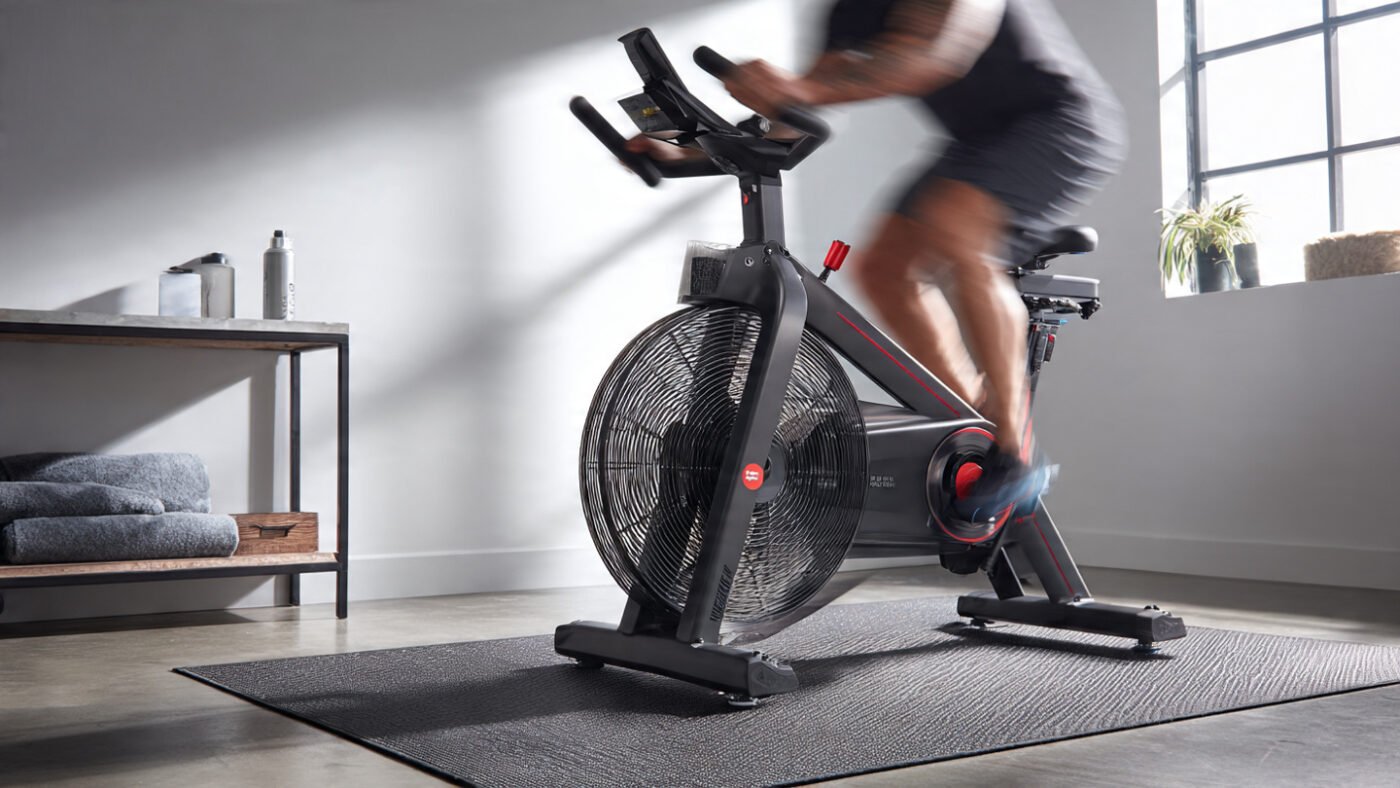
Airdyne Bike: Your Complete Guide to Full-Body Cardio Workouts
What’s Inside
If you’re looking to upgrade your home gym, an airdyne bike might be exactly what you need. These machines combine cardio and strength training in one package, letting you burn calories while building muscle across your entire body. Unlike regular exercise bikes that only work your legs, airdyne bikes use moving handlebars to get your arms, shoulders, and core involved too.
Fitness enthusiasts and CrossFit athletes have relied on these air resistance bikes for decades because they deliver results fast. You can torch up to 75 calories per minute during intense intervals. That’s significantly more than you’d burn on a traditional stationary bike. Plus, according to research published in Medicina, regular indoor cycling paired with a healthy diet improves aerobic capacity, blood pressure, and body composition.
Disclosure: This post contains affiliate links. If you purchase through our link, we may earn a small commission at no extra cost to you.
What Is an Airdyne Bike and How Does It Work?

An airdyne bike is a stationary exercise bike with a large fan instead of a traditional flywheel. When you pedal and push the moving handlebars, you spin the fan blades. This creates air resistance that automatically adjusts to your effort level.
The harder you push, the more resistance you feel. There’s no resistance knob to turn or settings to program. Your workout intensity is entirely up to you, making these bikes perfect for both beginners and advanced athletes.
Key Features That Set Airdyne Bikes Apart
- Air resistance system – The fan-based resistance means unlimited levels of difficulty. Whether you’re warming up or going all-out, the bike responds to your speed.
- Moving handlebars – Your arms pull and push while your legs pedal. This dual-action design engages your chest, back, shoulders, and core muscles.
- Cooling effect – As you work harder, the fan blows more air. You get a built-in cooling system that helps regulate body temperature during tough workouts.
Are Airdyne Bikes Better Than Regular Exercise Bikes?
It depends on your goals. Airdyne bikes excel at different things compared to spin bikes or upright bikes.
For full-body workouts and high-intensity interval training (HIIT), airdyne bikes win. Studies show you can burn 20-30 calories per minute on an air bike – that’s 600-900 calories in just 30 minutes. Regular bikes typically focus on lower body only and burn fewer calories.
However, traditional stationary bikes are quieter and better for steady-state cardio or longer endurance rides. If you want to watch TV or read while cycling, a regular bike might suit you better. Airdyne bikes are loud due to the fan and demand more attention because you’re working your entire body.
How Much Does an Airdyne Bike Cost?
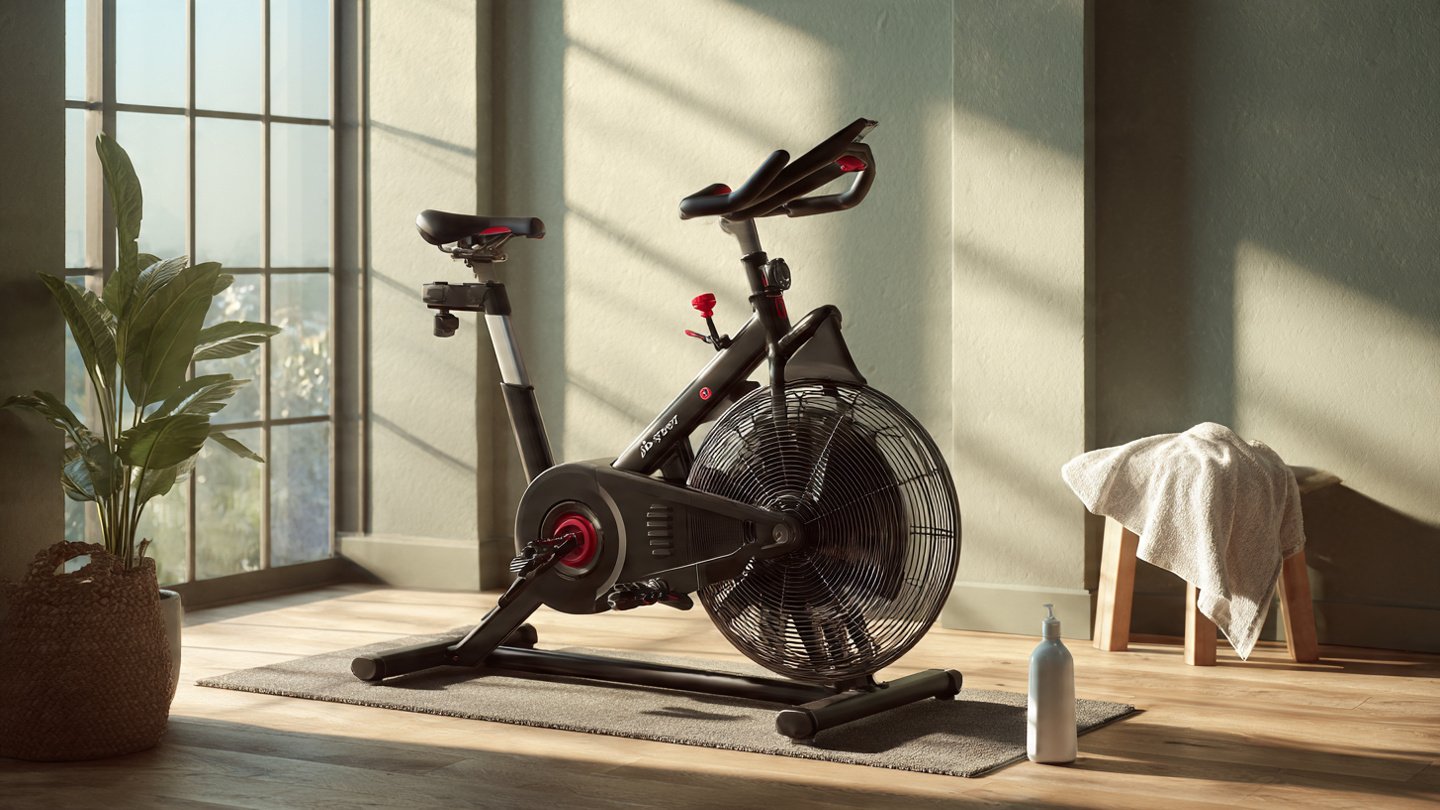
Prices for airdyne bikes range from about $250 for budget models to over $1,300 for premium options. Based on 2025 pricing:
- Budget range ($250-$400) – Entry-level models from brands like Marcy and Pooboo. These work fine for casual users but may lack durability for daily intense workouts.
- Mid-range ($500-$800) – Solid options from Bells of Steel and Titan Fitness. You’ll get better build quality and longer warranties.
- Premium ($900-$1,300) – Top-tier bikes like the Schwinn Airdyne AD7 and Assault Pro X. These feature belt drives (quieter operation), commercial-grade frames, and comprehensive warranties.
Most home users find the sweet spot around $600-$800. You get quality construction without overpaying for features you won’t use.
What Size Person Can Use an Airdyne Bike?
Most airdyne bikes accommodate riders between 5’0″ and 6’4″. Weight capacity usually ranges from 250 to 350 pounds depending on the model.
Height can be tricky though. Users under 5’2″ may struggle with reach, even with the seat fully lowered. Some report needing thick-soled shoes to comfortably reach the pedals. Taller riders (over 6’2″) should check that specific models offer enough seat height adjustment.
Popular Airdyne Bike Models Compared
| Feature | Marcy AIR-1 | Pooboo Exercise Bike | Marcy NS-1000 | Caromix Stationary Bike |
|---|---|---|---|---|
| Price Range | $250-$350 | $150-$250 | $300-$400 | $200-$300 |
| Weight Capacity | 300 lbs | 350 lbs | 250 lbs | 280 lbs |
| Resistance Type | Air only | Magnetic | Air + Friction | Air |
| Drive System | Belt + Chain | Belt | Belt | Chain |
| Display | Basic LCD | LCD with scan | LCD with scan | Digital LCD |
| Warranty | 2 years | 1 year | Limited | 1 year |
| Best For | Home users | Budget buyers | Moderate workouts | Casual exercise |
4 Best Airdyne Bikes
Best Overall Airdyne Bike
Marcy Air Resistance Exercise Fan Bike — unbeatable full-body performance for under $350
Why it won: True air resistance scales infinitely with effort, dual-action arms engage entire body, 14‑gauge steel frame rivals premium bikes, and the price leaves room for a gel seat cover — the only upgrade you’ll need. Quiet operation, easy assembly, and low‑impact design make it perfect for everyone from beginners to HIIT athletes.
Runner‑up: Pooboo Exercise Bike (best for ultra‑quiet magnetic resistance and apartment living).
1. Marcy Air Resistance Exercise Fan Bike
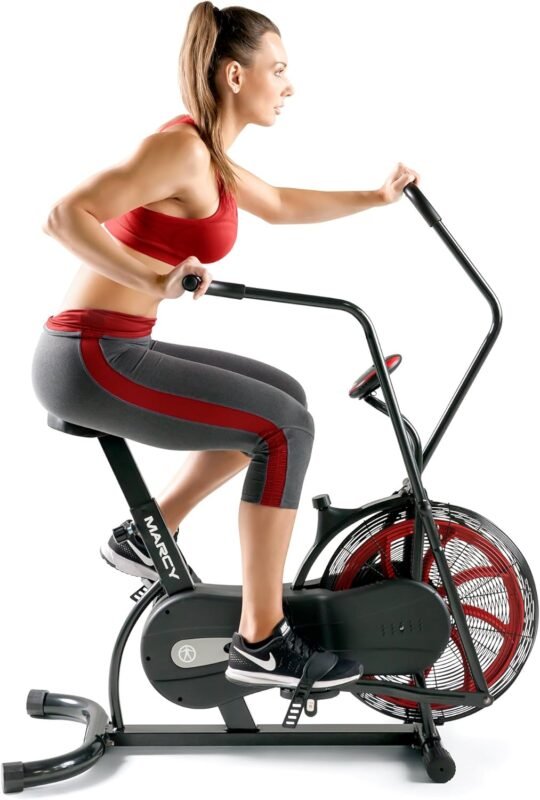
The Marcy Air Resistance Fan Bike punches well above its $268–$350 price tag. Built with heavy-duty 14-gauge steel and a powder-coated finish, this machine feels impressively solid — rivaling fan bikes costing two to three times more.
The air resistance system is its standout feature. The harder you pedal, the more resistance you generate, making it perfect for HIIT intervals and steady-state cardio alike. Dual-action handlebars engage your arms and shoulders, turning every session into a genuine full-body burn. The LCD display tracks time, speed, distance, and calories — nothing fancy, but it gets the job done.
✅ Pros
- Exceptional build quality for the price
- Infinitely variable air resistance
- Full-body workout with dual-action arms
- Surprisingly quiet operation
- Easy assembly with transport wheels
- Low-impact, joint-friendly
❌ Cons
- Seat uncomfortable beyond 30 min, no fore/aft adjustment
- Fan airflow blows sideways
- No Bluetooth or app connectivity
- Included wrench is poor quality
2. Pooboo Exercise Bike
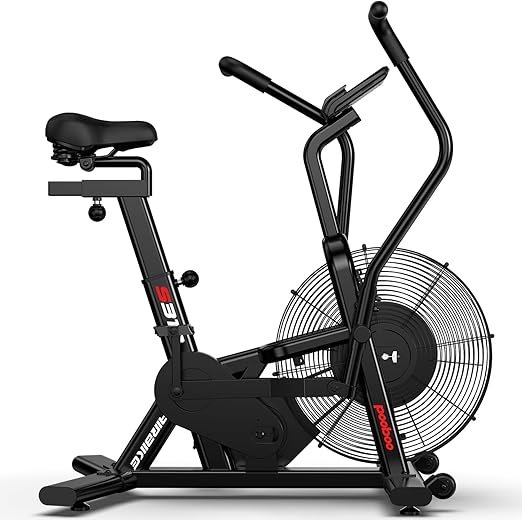
The Pooboo Stationary Bike is a serious budget contender that delivers features usually reserved for bikes costing two to three times more. Priced around $300–$540 depending on the model, it targets home gym users who want quiet, reliable cardio without a Peloton price tag.
At the heart of this bike is a 35-pound flywheel paired with a silent belt-drive magnetic resistance system — generating less than 20 dB of noise during use, which is outstanding for apartment dwellers or shared spaces. The 4-way adjustable seat and 2-way handlebars accommodate riders from 4’9″ to 6’4″, making it genuinely family-friendly. The LCD monitor tracks time, speed, distance, calories, and heart rate, and a tablet holder compensates for the screen’s dim backlight.
✅ Pros
- Ultra-quiet magnetic resistance system (under 20 dB)
- Heavy-duty steel frame supports up to 300–400 lbs
- 35 lb flywheel rivals bikes costing 3x more
- Fully adjustable fit for heights 4’9″–6’4″
- Quick assembly (under 30 min) with tools included
- Tablet mount and water bottle holder included
- 18-month full warranty
❌ Cons
- LCD screen is dim and lacks backlight clarity
- Not foldable — requires dedicated floor space
- Some users reported missing or dented parts on delivery
- No touchscreen or app/streaming integration
- Customer service inconsistent when parts are damaged
3. Marcy Exercise Upright Training Workout

The Marcy Exercise Upright Training Workout (Model AIR-1 / NS-1000) is a budget-friendly airdyne fan bike that delivers impressive full-body performance at a fraction of the cost of premium alternatives. Priced between $268–$350, it earns its strong 4.5/5-star average rating by punching well above its weight class.
The fan-based air resistance system is entirely self-regulating — the harder you pedal, the more resistance you face — making it equally suited for gentle senior cardio or explosive HIIT sprints. The dual-action handlebars engage your arms, shoulders, and chest simultaneously with your legs, while the built-in fan generates a cooling airflow during intense sessions. The LCD display clearly tracks time, speed, distance, and calories without any complicated setup.
✅ Pros
- 14-gauge steel construction rivals bikes costing 2–3x more
- Infinitely scalable air resistance — perfect for HIIT and recovery rides
- Dual-action arms deliver a true full-body workout
- Quieter fan operation than most competing fan bikes
- Compact footprint with front transport wheels for easy repositioning
- Quick and straightforward assembly (30–90 min); base comes pre-assembled
- Ideal for shorter users (4’11” to 5’5″) and seniors seeking low-impact cardio
❌ Cons
- Seat is firm and angled downward — a gel cover ($15–$25) is practically a must
- No forward/backward seat adjustment, only vertical height
- Fan airflow blows sideways rather than directly at the rider
- Basic LCD display — no app integration, Bluetooth, or workout programs
- Included wrench is poor quality; use your own tools
- Difficult to move across thick carpet
4. Caromix Folding Exercise Bike

The Caromix Folding Exercise Bike is a standout value in the under-$150 category, delivering features that routinely appear on bikes costing two to three times more. With a 4.5/5-star rating and proven real-world endurance — users have logged over 1,500 miles over 18 months — this compact machine earns serious credibility.
Its 5-in-1 design lets you switch between upright and semi-reclining positions, making it genuinely versatile for cardio, rehabilitation, and low-impact recovery sessions alike. The 16-level magnetic resistance system operates at under 20 dB, meaning early morning rides won’t wake anyone in the house. The X-shaped heavy-duty steel frame supports up to 330 lbs and shows zero wobble even during vigorous pedaling. Assembly arrives 70% pre-done and typically takes under an hour — one reviewer’s 9-year-old completed most of it independently.
✅ Pros
- Exceptional value at $100–$150
- Ultra-quiet operation under 20 dB — perfect for apartments
- 5-in-1 positions: upright, semi-reclining, and resistance band exercises
- 16 magnetic resistance levels from gentle rehab to intense cardio
- Accommodates heights from 5’1″ to 6’6″ — truly family-friendly
- 330 lb weight capacity with proven long-term durability
- Foldable with transport wheels — stores in ~2×2 ft of floor space
- Includes resistance bands, tablet holder, and water bottle holder
- 70% pre-assembled for quick, hassle-free setup
❌ Cons
- LCD display has no backlight — hard to read in dim rooms
- Resistance bands are too light for stronger or advanced users
- Heart rate sensors only function accurately in the upright position
- Calorie counter uses basic calculations, not personalized data
- Bolts require periodic tightening, especially for heavier users
- Included batteries often need immediate replacement out of the box
Can You Lose Weight Using an Airdyne Bike?
Absolutely. Regular use combined with proper nutrition creates the calorie deficit needed for weight loss. The key advantage is how efficiently these bikes burn calories.
A 2019 study in Medicina found that indoor cycling improves aerobic capacity and body composition when paired with healthy eating. The full-body engagement of airdyne bikes means you’re activating more muscle groups simultaneously, which increases your metabolic rate both during and after workouts.
Furthermore, the variable resistance makes interval training natural. You can push hard for 30 seconds, then recover at a slower pace. This HIIT approach has been shown to be more effective for fat loss than steady-state cardio alone.
What Muscles Does an Airdyne Bike Work?

Unlike traditional exercise bikes that primarily target your legs, airdyne bikes engage multiple muscle groups:
- Lower body – Quadriceps, hamstrings, glutes, and calves work constantly as you pedal.
- Upper body – Biceps, triceps, shoulders, chest, and back muscles activate as you push and pull the handlebars.
- Core – Your abs and lower back stabilize your body throughout the movement.
This total-body engagement is what makes airdyne bikes so effective for conditioning and cardiovascular fitness. You’re essentially getting a cardio workout and light resistance training in one session.
The beauty of the design is that you can shift emphasis. Push harder with your legs and you’ll feel it more in your quads. Focus on really driving the handlebars and your upper body takes on more work. This flexibility lets you target specific areas or balance the load evenly.
Are Airdyne Bikes Good for HIIT Training?
Yes – they’re considered one of the best tools for high-intensity interval training. The resistance responds instantly to your effort, which is exactly what HIIT demands.
Popular CrossFit gyms use air bikes extensively for this reason. You can go from a recovery pace to maximum effort in seconds without touching any controls. The exercise community refers to them as “devil’s tricycles” because they make HIIT workouts brutally effective.
Typical HIIT protocols on an airdyne bike:
- 20 seconds all-out effort / 40 seconds recovery (Tabata style)
- 30 seconds hard / 30 seconds easy
- 1 minute push / 2 minutes steady pace
The beauty of air resistance is that “all-out effort” truly means maximum exertion. The bike will keep challenging you no matter how fit you become.
Frequently Asked Questions
Q: How long should I ride an airdyne bike?
A: Start with 10-15 minute sessions if you’re new to intense cardio. Build up to 20-30 minutes as your endurance improves. For HIIT workouts, even 10-15 minutes can be incredibly effective when done at high intensity.
Q: Can I use an airdyne bike if I have bad knees?
A: Yes. The low-impact nature makes it easier on joints than running or jumping exercises. You can also reduce leg stress by using your arms more. However, consult your doctor before starting any new exercise program if you have existing injuries.
Q: Do I need special shoes for an airdyne bike?
A: No. Regular athletic shoes work fine. The pedals have straps to keep your feet secure. Some people prefer cycling shoes with clips, but they’re not necessary for effective workouts.
Q: How much space does an airdyne bike need?
A: Most models need about 4 feet by 2.5 feet of floor space. Add extra clearance around the bike for getting on and off safely. The bikes typically can’t fold for storage, so plan for permanent placement.
Q: Are airdyne bikes worth the money?
A: If you want efficient, full-body cardio at home, yes. The versatility and calorie-burning potential justify the cost for most users. Budget models around $300 offer good value for casual use. Serious athletes should invest $600+ for durability.
Q: Can beginners use airdyne bikes?
A: Absolutely. The self-adjusting resistance means you control the intensity. Start slowly and gradually increase your effort. The bike won’t fight you – it simply matches whatever energy you put in.
Q: How do airdyne bikes compare to rowing machines?
A: Both provide full-body cardio. Rowing machines emphasize back and leg muscles more. Airdyne bikes are easier to learn and maintain consistent intensity. Rowers require proper form to avoid back strain. Choose based on which movement pattern you prefer.
Q: What maintenance do airdyne bikes need?
A: Minimal upkeep required. Wipe down after sweaty workouts to prevent corrosion. Check and tighten bolts periodically. Belt-driven models need even less maintenance than chain-driven bikes. Occasionally clean dust from the fan blades.
Final Thoughts: Is an Airdyne Bike Right for You?
An airdyne bike makes sense if you want challenging, time-efficient workouts that build both cardio endurance and muscular endurance. The full-body engagement sets these bikes apart from standard exercise equipment.
They’re particularly valuable for people who:
- Enjoy high-intensity training
- Have limited workout time
- Want to burn maximum calories
- Need low-impact exercise options
- Train for sports requiring whole-body conditioning
On the other hand, skip the airdyne bike if you prefer quiet, leisurely workouts while watching movies. Traditional stationary bikes suit that style better.
