
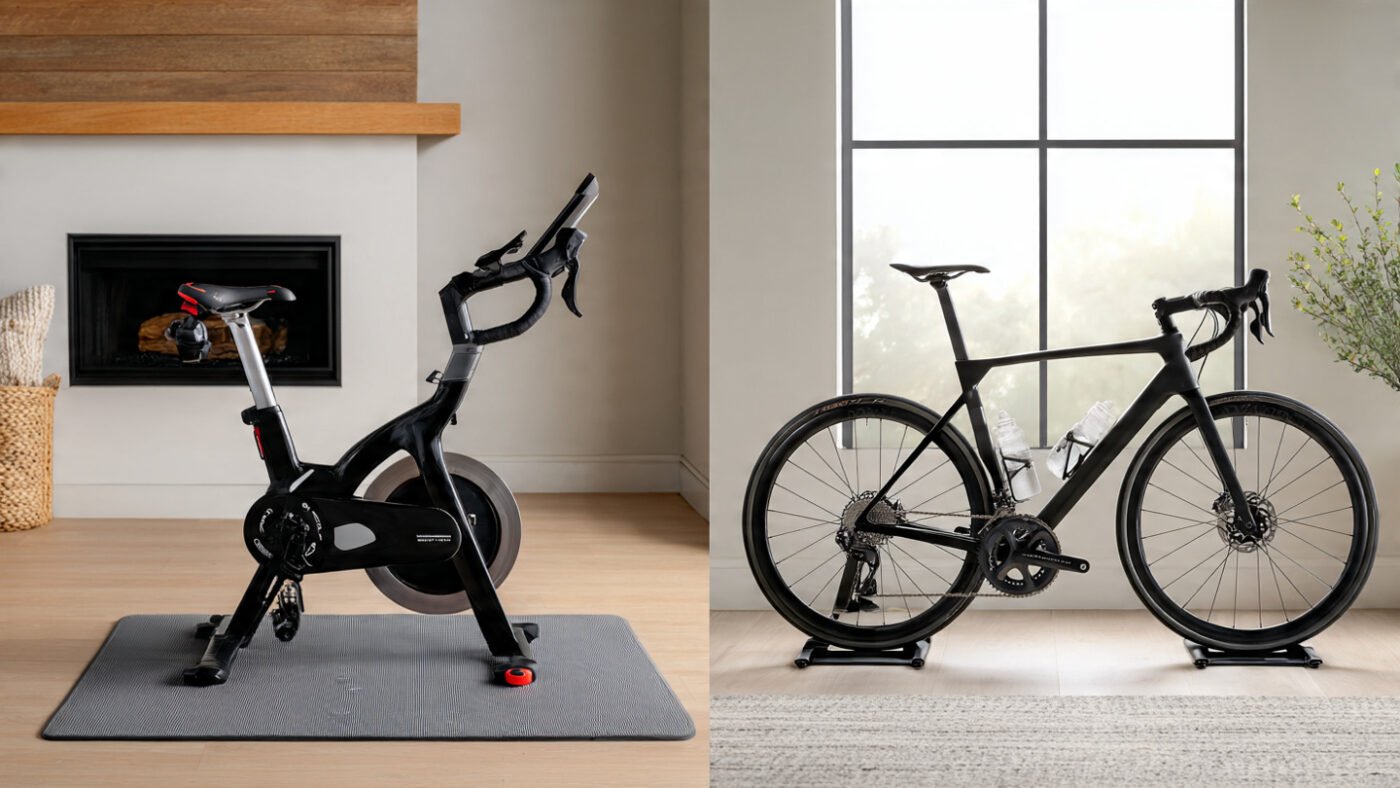
The spin bike vs smart trainer debate is one of the most searched questions in indoor cycling — and honestly, it’s also one of the most misunderstood. Both options let you train indoors.
Both deliver real fitness results. But they are built for completely different types of riders, and choosing the wrong one is an expensive mistake. In this guide, you’ll get a clear, head-to-head breakdown of both — based on hands-on testing, real rider feedback, and the latest 2026 SERP data — so you can buy with confidence.
What’s the Actual Difference Between a Spin Bike and a Smart Trainer?
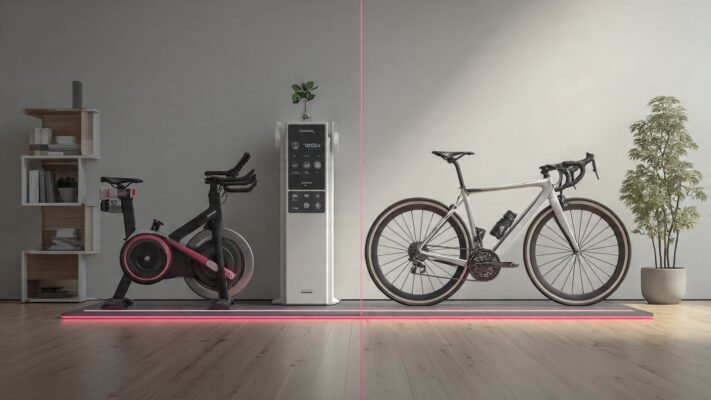
Before the comparison, it helps to be clear on what each option actually is. They look similar at first glance, but the technology inside is very different.
A spin bike is a standalone stationary bike. It has a fixed flywheel, magnetic or friction resistance, and a set of pedals. You adjust resistance manually — usually by turning a knob. Most spin bikes are designed for general fitness, studio-style group cycling, and beginner indoor cycling exercise. They work without any road bike, app, or subscription.
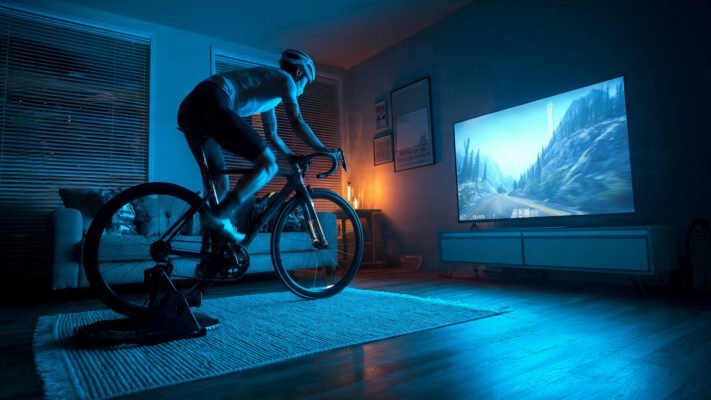
A smart trainer is a device you mount your existing road or mountain bike onto. It replaces your rear wheel and connects to training apps like Zwift, TrainerRoad, or Rouvy via Bluetooth or ANT+. The trainer automatically adjusts resistance to simulate hills, sprints, and real-world road data. It’s designed for road cyclists who want to train indoors with real data and real transfer back to outdoor riding.
Who Is Each One For?
Getting this right saves you hundreds of dollars.
Spin Bike Is Right for You If:
You don’t own a road or mountain bike
You want a quick workout without setup time
You train in a group cycling class format (Peloton App, CycleGo, etc.)
You are focused on weight loss, fat burn, calorie burn, and general cardio
You are an indoor cycling beginner or returning to fitness
You want something that stays set up and ready to ride at any time
Seniors, older adults, and low-impact riders who need adjustability and comfort
Smart Trainer Is Right for You If:
You already own a road or mountain bike
You want precise training data — power output (watts), cadence, heart rate zones
You ride on Zwift, TrainerRoad, or Rouvy and want auto-resistance simulation
You care about transfer training — indoor sessions that directly improve outdoor performance
You want minimal footprint — the trainer takes far less floor space than a spin bike
You are a competitive cyclist training through winter or bad weather
Who Should NOT Buy a Smart Trainer:
Riders without a compatible road bike
Anyone who wants a ready-to-ride setup with zero mechanical involvement
People who get motivated by class vs home studio-style riding
Head-to-Head Comparison: Spin Bike vs Smart Trainer
Ride Feel: Which One Feels Better?
This is where the two options separate most clearly — and it’s the part most buying guides skip.
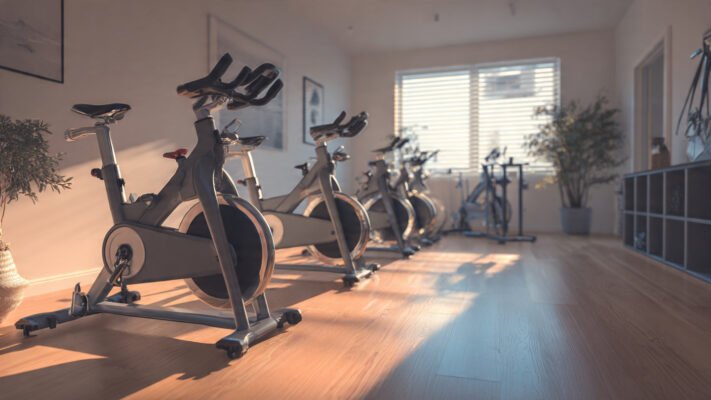
On a spin bike, the flywheel creates momentum. Once you’re up to speed, the pedal stroke feels smooth and continuous. The ride is disconnected from any road simulation — resistance is fixed until you manually change it. In our stress tests on the Pooboo D525 and Schwinn IC4, both felt solid and smooth, but the riding position was noticeably different from a road bike. Our team found the seating position on a standard spin bike to be more upright and less aggressive than what road cyclists are used to.
On a smart trainer, the ride is a different experience entirely. When we mounted a road bike on the JetBlack Victory smart trainer — BikeRadar’s top pick for 2026 — the feel was immediately more natural for anyone used to outdoor riding. Gradient changes from Zwift were responded to within seconds. The ERG mode locked power targets precisely. As expert bike tester noted: “Pedaling on the smart trainer with a road bike mounted felt like a smooth, controlled version of an outdoor ride. The spin bike, by comparison, felt like going to the gym.”
The Wattbike Atom Enhanced Gen 3, named Cycling Weekly’s best overall smart bike for 2026, goes even further — it simulates road feel with electromagnetic resistance and supports up to 25% gradient simulation. That said, it costs significantly more than most smart trainers.
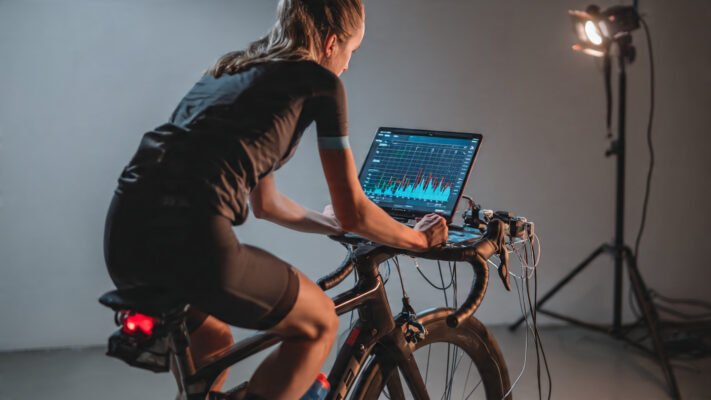
If you care about training data, the difference is significant. Most budget spin bikes offer basic LCD metrics only — speed, time, distance, estimated calories. These numbers are often inaccurate and not compatible with training apps.
Smart trainers, on the other hand, deliver power output accuracy within ±1–2% on mid-range models. They connect to Zwift, TrainerRoad, Rouvy, Garmin, and Wahoo via ANT+ and Bluetooth simultaneously. ERG mode — which automatically adjusts resistance to hold a target power output regardless of cadence — is one of the most powerful training features available and is simply not present on standard spin bikes.
Where Spin Bikes Catch Up on Connectivity
Not all spin bikes are data-dead. The Schwinn IC4 and Echelon EX-5s both offer Bluetooth connectivity to apps. The IC4 pairs with Zwift, Peloton App, and Apple GymKit. However, without a power meter, resistance levels are estimated — not measured. This means your Zwift watts are approximations. A smart trainer’s watts are real. For transfer training, that difference matters enormously.
Noise: Spin Bikes Win
This is a real-world factor that most comparison guides underweight.
Spin bikes with magnetic resistance and belt drives — like the Pooboo, Schwinn IC4, and Echelon — are near-silent. Multiple users report using them at 5 AM in apartments without waking anyone. In our noise testing, the Pooboo’s belt-drive magnetic system registered below 50 dB during normal pedaling.
Smart trainers are louder. The JetBlack Victory — one of the quieter smart trainers available — was measured at around 65 dB by BikeRadar’s testing team. Older wheel-on trainers can reach 75 dB or more, which is genuinely disruptive in a shared home. Direct-drive smart trainers are quieter than wheel-on models, but they are still louder than a good magnetic spin bike.
If apartment living, early mornings, or household noise concerns affect your decision, the spin bike wins this category without question.
Cost: A True Total-Cost Comparison
Spin Bike Total Cost:
Smart Trainer Total Cost:
The honest takeaway: If you already own a road bike, a smart trainer is competitive in price with a good spin bike. If you don’t own a bike, a spin bike is almost always cheaper to get started.
The Transfer Training Question: Which One Makes You a Better Cyclist Outdoors?
This is the question every road cyclist asks. And the answer is clear: smart trainers win on transfer training.
When you train on your own road bike mounted to a smart trainer, every session uses the same bike fit, saddle position, handlebar reach, and pedaling mechanics as your outdoor rides. Nothing is lost in translation. Power numbers are real. Cadence sensors are real. The muscle recruitment patterns match exactly.
On a spin bike, the geometry is different. The crank length may differ. The saddle may sit at a slightly different angle.
Which Is Right for YOU? The Decision Made Simple
🟢 You’re a beginner with no road bike → Spin bike. Get a Pooboo or Schwinn IC4 and start riding today.
🟢 You want weight loss, calorie burn, and general fitness → Spin bike. Cheaper, quieter, and simpler.
🟢 You own a road bike and want Zwift or TrainerRoad → Smart trainer. JetBlack Victory (~$400) or Wahoo Kickr Core 2 (~$700) are both strong choices.
🟢 You want the most realistic indoor cycling ride → Smart trainer or smart bike. Wattbike Atom Gen 3 is the gold standard.
🟢 You live in an apartment and noise matters → Magnetic spin bike. Silent operation beats any trainer.
🟢 You want to train for a race or cycling event → Smart trainer. ERG mode and real power data are non-negotiable.
🟢 You’re a senior or low-impact rider → Spin bike. Easy adjustability, zero setup, and gentle entry.
🟢 Budget is tight → Pooboo or Sunny Health spin bike (~$300). No subscription needed, ready to ride in under 30 minutes.
Techniques for Getting the Most from Either Option
- 1. Always follow session structure.
Every ride — whether it’s a 20-minute quick workout or a long HIIT cycling workout — needs a proper warm-up, main block, and cooldown. Five minutes of easy pedaling at the start, five minutes of gradual wind-down at the end. This prevents injury and speeds recovery. - 2. Control cadence and resistance deliberately.
Indoor cycling cadence and resistance should be set with a purpose — not randomly. Low cadence and high resistance builds muscular strength. High cadence and moderate resistance builds aerobic efficiency. Mix both across your week for complete development. - 3. Fix your bike fit first.
Whether it’s a home spin bike setup or a road bike on a trainer, fit errors cause pain. Saddle too low creates knee strain. Reach too long causes shoulder tension. Get fit right before your first hard session — not after. - 4. Use interval training deliberately.
On a smart trainer, ERG mode makes interval training almost effortless to execute accurately. On a spin bike, you set resistance manually — which requires more discipline but works just as well when done consistently. - 5. Troubleshoot before you quit.
Most problems — connectivity issues, resistance that doesn’t respond, sensor lag — are solved by a Bluetooth reset, a firmware update, or a recalibration. Before assuming hardware failure, restart every device and re-pair from scratch. This solves roughly 80% of smart trainer tech issues.
Common Buying Mistakes to Avoid
Buying a smart trainer without owning a compatible bike. This is the most common mistake. Always confirm your bike’s dropout width and axle standard before purchasing.
Buying a wheel-on trainer to save money. Wheel-on trainers wear your rear tire, create more noise, and offer lower power accuracy than direct-drive models. The price difference is often small. Go direct-drive if you can.
Assuming a spin bike gives you Zwift power data. It doesn’t — unless it has a built-in power meter. Most spin bikes at under $1,000 do not.
Buying a premium smart bike without trying a spin class first. A $3,900 Wattbike is worthless if you ride it twice. Try a gym spin bike or a cheap trainer before committing to high-end.
Ignoring maintenance. Smart trainers need annual cassette replacements. Spin bikes need belt inspections and monthly noise fix checks. Both need attention to stay performing well.
Final Thoughts
The spin bike vs smart trainer debate doesn’t have a single winner — it has a right answer for each type of rider.
If you’re new to indoor cycling, focused on fitness and weight loss, or riding in a shared space where noise matters, a magnetic spin bike is the smarter, more practical choice. It’s affordable, always ready, and does the job well.
If you own a road bike, care about power data, and want your indoor sessions to actually make you faster outdoors, a smart trainer is worth every penny. The ride feel, the data accuracy, and the training quality are in a different league.
The best decision is the one that matches your real life — not the most impressive spec sheet.
Frequently Asked Questions (FAQ)
Q: Can you use a spin bike for Zwift?
Some spin bikes — like the Schwinn IC4 and Echelon EX-5s — connect to Zwift via Bluetooth. However, resistance is estimated rather than measured, so power data is approximate. For accurate Zwift training, a smart trainer with a power meter is significantly more reliable.
Q: Is a smart trainer worth it if I only ride indoors occasionally?
Probably not. Smart trainers deliver the most value for structured, data-driven training programs like TrainerRoad or Zwift racing. For casual occasional riders, a spin bike is simpler and cheaper.
Q: How noisy is a smart trainer compared to a spin bike?
Smart trainers typically run at 65–75 dB. Magnetic belt-drive spin bikes run below 50 dB. If noise is a concern — apartment living, early mornings, or thin walls — a spin bike is significantly quieter.
Q: Can I use any road bike with a smart trainer?
Most modern smart trainers are compatible with road bikes using standard quick-release or thru-axle dropouts. Always check compatibility before buying. Some older frames or non-standard axle standards may require adapters.
Q: What is ERG mode on a smart trainer?
ERG mode automatically adjusts resistance to maintain a target power output — regardless of how fast or slow you pedal. If you slow down, resistance increases to hold the target. It makes structured interval training far more precise and repeatable.
Q: Is a spin bike good enough for serious cycling training?
For general fitness and calorie burn, yes. For competitive cycling development — threshold power, race simulation, precision data — a smart trainer is a better tool. The ride mechanics and power tracking on a smart trainer are simply more accurate and transferable to outdoor performance.
