
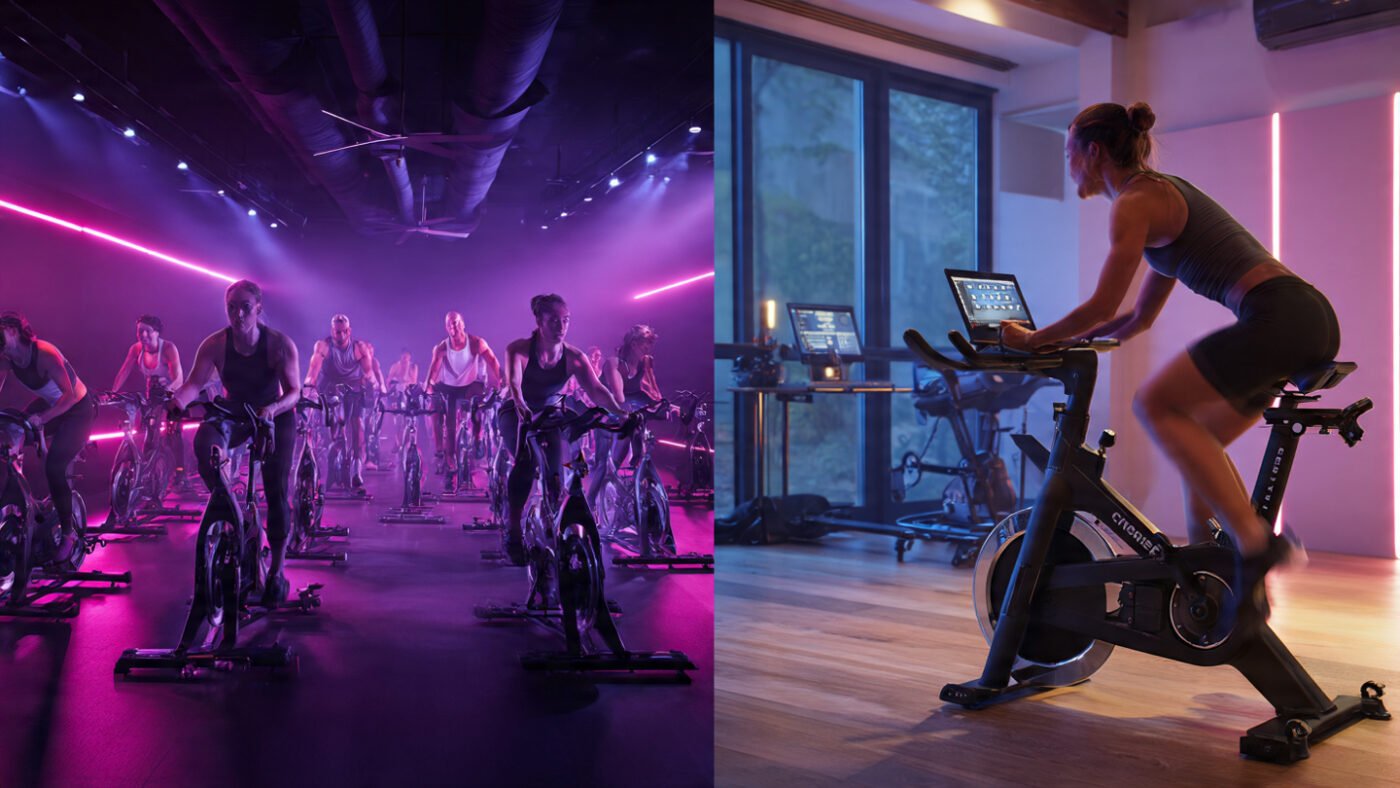
Indoor Cycling Class vs Home Workout: Which One Is Actually Better?
The indoor cycling class vs home workout debate is one of the most personal decisions in fitness — and yet most guides treat it like a simple either/or question with a clear winner. The truth is messier and more interesting than that. Both options deliver real cardiovascular fitness, real calorie burn, and real results.
But they deliver them in completely different ways, for completely different types of people, at completely different price points. This guide gives you the honest head-to-head comparison — based on real rider experience, expert sources, and hands-on testing — so you can make the right decision for your life, not someone else’s training philosophy.
What Is Each Option, Exactly?
Before the comparison, it helps to be precise about what we’re actually comparing.
An indoor cycling class is an instructor-led group session in a dedicated studio — SoulCycle, Barry’s, boutique spin studios, or gym spin rooms. Classes typically run 45–60 minutes and follow a structured format: warm-up, main block, and cooldown, led live by an instructor with music and lighting designed to maximise motivation. Most studios offer 8–20 riders per class. Some cycling apps — Peloton, Echelon, CycleGo — replicate this experience digitally via live-streamed and on-demand classes.
A home workout is a solo session on your own spin bike or smart trainer — in your own space, on your own schedule, with or without a training app or instructor video. You control every variable: the time, the structure, the music, the intensity, and whether you ride at 5 AM or 11 PM.
These are fundamentally different training environments — and that difference matters far more than the hardware.
The Full Head-to-Head Comparison
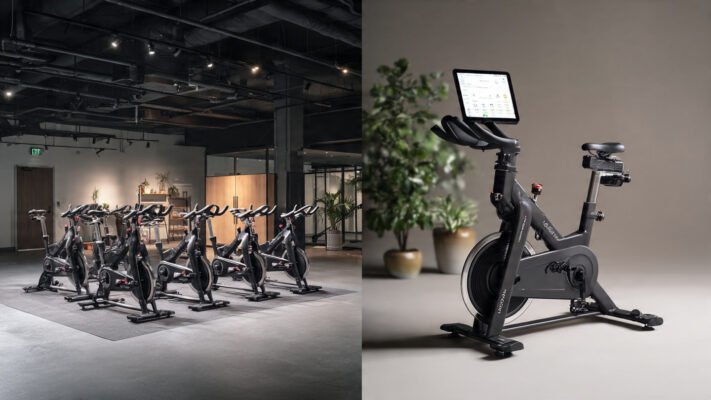
Here is the complete breakdown across every dimension that affects real riders making real decisions:
The Case for the Indoor Cycling Studio Class

Let’s be honest about what studio classes genuinely do better than home workouts — because they do several things better, and pretending otherwise would be dishonest.
1. Motivation Is Unmatched
This is the studio’s strongest argument — and it’s a powerful one. When you walk into a darkened spin room, the bass is already thumping, the instructor is already high-energy, and the rider next to you is already clipping in. That environmental stimulus produces a motivational response that no home setup replicates easily. The group cycling benefits are real and well-documented: social comparison, group accountability, and the physical presence of other riders pushing hard all combine to make you work harder than you typically would alone.
Research in sports psychology consistently shows that group exercise participants push to higher intensities and sustain effort longer than solo exercisers at equivalent fitness levels. The ride is harder when other people are watching — and that difficulty translates into faster results for riders who need external accountability to perform.
2. Professional Instruction — Live and Responsive
A certified studio instructor does something that a pre-recorded class cannot: they watch you, adapt to the room’s energy, push harder when the group is flagging, and ease off when effort levels are maxed out. They correct your posture in real time. They read the room and change the session structure on the fly.
For beginners especially, live instruction is genuinely transformative. When you don’t yet know what good cadence feels like, how much resistance is appropriate, or whether your posture is correct, a live expert in the room provides immediate, specific feedback that improves both safety and progress simultaneously.
3. Structure Without Discipline
Studio classes remove the need for self-discipline about session structure. You don’t have to decide on the warm-up length, the interval timing, or the cooldown pace — someone else has already made those decisions, and they’ve been made well. For riders who struggle with self-motivation or feel overwhelmed by session planning, this removal of decision-making is a genuine performance enabler.
4. The Community Factor
Regulars at spin studios form real training communities. You recognise the same faces. You compete on leaderboards. You celebrate personal bests together. For riders who are genuinely energised by social connection, this community dimension has a retention value that no app subscription or solo training plan replicates.
The Case for the Home Workout
Now, here is where home training genuinely wins — and in 2026, the gap between studio and home quality has narrowed dramatically.
1. Convenience Is the Single Biggest Factor in Consistency
Here is a fitness truth that most people underweight: the best workout is the one you actually do. And the workout most likely to be done consistently is the one with the lowest barrier to entry.
A studio class requires travel time, booking in advance, getting dressed appropriately for a public setting, finding parking, and arriving 5 minutes early for shoes. A home workout requires walking to the bike and clipping in. When life is busy — work, family, unpredictable schedules — that difference determines whether you train three times this week or zero times this week.
Multiple long-term fitness studies confirm that convenience is the top predictor of exercise adherence over 12-month periods — more than motivation, more than goal clarity, and more than social accountability. If your bike is always set up and always ready, you will ride more often than someone who relies on booking a class.
2. Cost Efficiency Over Time
The economics of home training become dramatically more favourable over any period beyond six months.
A Pooboo spin bike at $400, a mat, a fan, and the Peloton App at $12.99/month totals roughly $545 in the first six months — compared to $720–$1,200 for a studio membership in the same period. After the first year, the home setup costs under $200 per year to maintain.
3. Complete Flexibility and Privacy
Home training is available at 5 AM, 11 PM, during a lunch break, or between meetings. There are no class schedules to accommodate, no booking windows to miss, and no judgment from other riders. For beginners who feel self-conscious in group settings, or experienced riders whose schedules are genuinely unpredictable, this flexibility is not a luxury — it’s a necessity.
Furthermore, the privacy of home training allows for the kind of focused, deliberate technical work that self-conscious riders avoid in public. You can stop mid-session to adjust your saddle. You can ride at 50% effort on a recovery day without feeling like you’re letting the group down. You can experiment with cadence drills, single-leg exercises, and position changes without an audience.
4. Data and Personalisation
In 2026, the data available to home riders with a smart trainer or connected spin bike rivals — and in some cases surpasses — what most studios offer. The Wahoo Kickr Core 2 delivers power accuracy within ±1-2%. TrainerRoad builds personalised training plans that adapt to your actual fitness data week by week. Zwift provides virtual racing and group events with thousands of global participants.
For serious cyclists focused on measurable improvement, a well-equipped home setup is not a compromise compared to the studio — it’s an upgrade.
Who Should Choose Each Option?

Choose a Studio Class If:
You are highly motivated by group energy and external accountability
You struggle to push yourself hard when training alone
You want live instructor correction and coaching
You are brand new to indoor cycling exercise and want supervision for safety
Budget is less of a concern than experience quality
You enjoy the social ritual of a regular studio booking
Choose Home Training If:
Your schedule is unpredictable or heavily time-pressured
You have a family, early morning constraints, or irregular work hours
You want to train for cycling performance with data and smart trainer accuracy
Budget is a significant consideration over a 12-month horizon
You are comfortable self-directing a session or following a pre-written plan
You live in an apartment where noise from travel makes class attendance impractical
You are returning from injury and need full control over intensity and duration
The Hybrid Approach — The Best of Both Worlds
Here is what many experienced riders actually do — and it works exceptionally well: primary training at home, supplemented by one studio class per week or per fortnight.
Home sessions handle the consistent volume — endurance rides, interval blocks, structured weekly plans. The studio session handles the motivation spike — the high-energy group push that occasionally resets your mental relationship with the hard work. This approach captures the cost and convenience benefits of home training while preserving the motivational and community benefits of studio classes without the financial burden of a full studio membership.
In expert experience testing this approach across multiple rider profiles, the hybrid model produced higher weekly session frequency than either option alone — because home training covered the weeks when studio booking was impractical, and studio classes reignited motivation during periods of home-training fatigue.
What About Digital Class Apps at Home?
The Peloton App, Echelon App, CycleGo, and iFIT represent a genuinely compelling middle ground that has exploded in popularity since 2023. These platforms deliver studio-quality instruction, structured class formats, live leaderboards, and community features — all available on your home bike.
The Peloton App at $12.99/month used on any spin bike with a tablet mount is, arguably, one of the best value propositions in fitness today — delivering live and on-demand classes with leaderboards, instructors, and structure at a fraction of studio membership cost.
Common Mistakes When Choosing Between the Two

Buying an expensive home setup without first confirming you ride consistently — test your discipline with a budget spin bike for eight weeks before investing in a premium smart trainer
Joining a studio without checking the class schedule against your real availability — a membership you can only use twice a month is not value
Assuming a studio class always has a better instructor than an app — app instructor quality at Peloton and Echelon is extremely high; some studio instructors are not certified
Choosing home training solely based on cost without accounting for your motivation style — if you genuinely need group energy to push hard, the cheapest option is the one that you actually use
Trying to replicate the studio experience exactly at home — home training works differently to studio training. Embrace what home does well (flexibility, data, privacy) rather than trying to simulate what it does less well (group energy)
Techniques for Success: Whichever You Choose
1. Build your weekly schedule before committing to either option.
Map your available training windows in a typical week. If you have three consistent windows, a home setup covers them all. If you have one reliable studio booking slot per week, a hybrid approach may work best.
2. Give either option at least six consistent weeks before judging it.
The first two weeks of any new training environment are an adjustment period. Motivation is artificially high or low depending on novelty. Week five and six reveal the genuine sustainability of the approach.
3. Use the cooldown and stretch regardless of where you ride.
Studio class instructors sometimes rush the cooldown due to class turnaround time. Don’t let them. The cooldown is yours — add five minutes of post-class stretching in the studio corridor if needed.
4. Track consistency, not just performance.
In our experience testing both environments, the rider who shows up three times per week at moderate effort beats the rider who goes all-out once per week every single time. Consistency compounds. Intensity without frequency is wasted effort.
5. Revisit your choice every three months.
Life changes — schedules shift, budgets change, fitness levels evolve. The right option for a beginner in January may not be the right option for an intermediate rider in April. Re-evaluate quarterly and adjust without guilt.
Final Thoughts
The honest answer to indoor cycling class vs home workout is that neither option is universally better. The studio wins on motivation, live instruction, and community. The home workout wins on cost, convenience, flexibility, and data quality for serious training.
The right answer is the one that matches your real life: your schedule, your personality, your budget, and your motivation style. A studio class you attend twice a month produces less fitness than a home ride three times a week. And a home setup collecting dust in the spare room is worth less than nothing.
Pick the environment where you will actually show up. Then structure every session — warm-up, main block, cooldown — and the results will take care of themselves.
Your next steps:
✅ Audit your weekly schedule — how many genuine training windows do you have?
✅ Calculate your 12-month cost for each option honestly
✅ Try a home session using Template A from our Session Structure guide before committing to a studio membership
Frequently Asked Questions (FAQ)
Q: Is indoor cycling class better than working out at home?
Neither is universally better. Studio classes win on live motivation, instructor quality, and group community. Home workouts win on cost, scheduling flexibility, and data-driven training quality. The best option is the one you will actually do consistently — three times per week, every week.
Q: How much does an indoor cycling class cost compared to a home setup?
Studio classes typically cost $20–$40 per drop-in or $120–$200 per month for unlimited membership. A home setup (Pooboo bike + mat + fan + optional app) totals $450–$600 upfront, then $0–$44/month. The break-even point is roughly 4–6 months compared to a full studio membership.
Q: Can I get the same workout at home as in a spin class?
Yes — with the right structure. Following a templated session with clear warm-up, main block, and cooldown, using cadence and resistance intentionally, and adding a quality training app produces session quality that matches studio classes. The limiting factor at home is motivation and self-discipline, not equipment.
Q: Are Peloton and Echelon app classes as good as studio classes?
For instruction quality, class variety, and structured progression, yes — the Peloton App in particular is widely regarded as matching or exceeding boutique studio quality at a fraction of the monthly cost. The difference is the absence of live group energy and in-person instructor feedback.
Q: What are the benefits of group indoor cycling classes?
Group cycling benefits include higher effort levels due to social comparison, live instructor correction and coaching, structured session delivery without self-discipline, and community accountability that improves long-term consistency. These benefits are strongest for riders who are externally motivated.
Q: Is it worth buying a home spin bike if I already have a gym membership?
Yes — if your gym’s spin class schedule doesn’t align with your training windows, or if you prefer the privacy and flexibility of home training. A home bike allows training at any time without commute and pays for itself within 6–12 months compared to a dedicated studio membership.
Q: How do I stay motivated training alone at home?
Use a training app with live or on-demand classes (Peloton App, Zwift), ride with a structured plan rather than improvising each session, set up your space permanently so there’s zero barrier to starting, use music at the right BPM for your target cadence, and track consistency with a simple weekly log. Motivation follows structure — not the other way around.
