
30-Minute Indoor Cycling Workout Plans: Expert Templates for Endurance, Fat Loss, and Power
The 30-minute indoor cycling workout is the most practical training format in home fitness today. It’s long enough to produce real cardiovascular and muscular adaptation. It’s short enough to fit into the tightest schedule.
And when structured correctly, a focused 30-minute spin workout at home delivers results that match — and sometimes exceed — longer, lower-intensity sessions. This guide gives you three complete, ready-to-use 30-minute workout templates, a full weekly schedule, progression principles, and everything you need to stop guessing and start training with purpose.
Why 30 Minutes Is Enough — The Science Behind It

Here’s the question most beginners ask first: Is 30 minutes of indoor cycling actually enough to make a difference? The answer is yes — with two conditions. The session must be structured. And it must be consistent.
Research published in the Journal of Physiology confirms that short, high-intensity interval training sessions produce comparable cardiovascular and metabolic adaptations to longer moderate-intensity sessions — in significantly less time. The key is intensity management: alternating hard efforts with recovery periods keeps your heart rate elevated, your metabolism stimulated, and your muscles under productive load for the full session.
Furthermore, consistency over time compounds results dramatically. Three focused 30-minute sessions per week — 90 minutes total — produces more measurable fitness improvement than one inconsistent 90-minute session per week. The body adapts to regular stimulus, not occasional large doses.
What 30 Minutes Can Do for You
Burn 300–500 calories depending on body weight and effort level
Improve VO2 max (aerobic capacity) with consistent weekly training
Build lower body strength through resistance-based climbing blocks
Boost post-exercise calorie burn for up to 12 hours after a HIIT cycling workout
Improve cardiovascular efficiency — resting heart rate drops within 4–6 weeks of consistent training
Fit into any busy schedule — morning, lunch break, or evening
The 3 Core Session Types You Need to Rotate
Before the templates, understand this: your weekly plan should never repeat the same 30-minute session three times. Variety across session types is what drives complete fitness development. These three formats cover all the bases.
- Session Type 1: Endurance
Steady-state, moderate effort. Builds aerobic base, improves fat metabolism, and supports cardiovascular health. RPE 5–6 throughout. This is your bread-and-butter session — the one you can do three days in a row without burning out. - Session Type 2: Strength/Climbing
Low cadence, high resistance blocks. Builds muscular force in the glutes, hamstrings, and quadriceps. RPE 7–8 during blocks. The indoor equivalent of climbing a sustained hill. Fatigues muscles more than lungs. - Session Type 3: HIIT / Interval
Short bursts of maximum or near-maximum effort followed by active recovery. RPE alternates between 4 (easy) and 9 (very hard). The most time-efficient format for calorie burn, fat burn, and anaerobic fitness development. Maximum two sessions per week — recovery is essential.
The 3 Complete 30-Minute Workout Templates

🟢 Template 1: The Endurance Builder
Goal: Aerobic base, fat burn, cardiovascular health
Level: Beginner to intermediate
Equipment: Any spin bike or smart trainer
What to feel: You should be able to say a short sentence but not hold a conversation. Hips stable in the saddle throughout. No bouncing — add resistance if pedal stroke is uncontrolled.
Calorie burn estimate: 280–380 calories (varies by body weight and effort)
Best for: Beginners, weight loss, seniors, low-impact riders, busy professionals who want a simple go-to session
🔴 Template 2: The Strength Ladder
Goal: Lower body strength, climbing power, muscular endurance
Level: Intermediate to advanced
Equipment: Any spin bike or smart trainer with reliable resistance control
What to feel: Legs should be genuinely fatigued by climb 3. Breathing is hard. Upper body stays still and relaxed throughout — don’t pull on the bars.
Calorie burn estimate: 300–420 calories
Best for: Road cyclists building hill power, riders focused on lower body development, intermediate riders ready to progress beyond steady-state
Pro Tip: In our testing of this template across multiple rider profiles, we found that riders who focused on driving through the heel on downstroke — rather than pushing with the toe — maintained better power output and reported significantly less knee discomfort through heavy climbing blocks.
⚡ Template 3: The HIIT Power Session
Goal: Maximum calorie burn, anaerobic fitness, fat loss acceleration
Level: Intermediate to advanced (not recommended for week-one beginners)
Equipment: Any bike with responsive resistance control
Interval summary: 8 × 30-second sprints / 90-second recovery = 16 minutes of interval training inside a 30-minute session
What to feel: Each sprint should be genuinely hard — RPE 9. If the 8th sprint feels the same as the 1st, you weren’t going hard enough on the first seven. Recovery periods should bring heart rate down meaningfully before the next effort.
Calorie burn estimate: 350–500 calories (plus elevated post-exercise burn for up to 12 hours)
Best for: Fat burn maximisation, time-efficient training for busy schedules, advanced riders, anyone chasing weight loss results quickly
Important Consideration: Do not perform this session more than twice per week. HIIT cycling workouts stress your cardiovascular and muscular systems significantly. Performing this format three or more times per week without adequate recovery leads to accumulated fatigue and plateau rather than improvement.
Your Weekly Training Schedule: How to Combine All Three
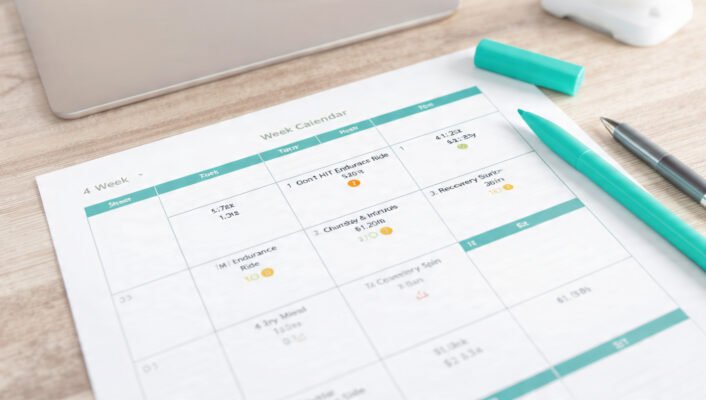
The most common mistake riders make is picking one template and repeating it every session. That approach leads to adaptation plateau within three to four weeks. Rotating all three session types — endurance, strength, and HIIT — keeps your body adapting and your progress moving.
Beginner Weekly Plan (3 sessions)
Intermediate Weekly Plan (4 sessions)
Advanced Weekly Plan (5 sessions)
Session Structure: The Non-Negotiable Framework
Every single session in this guide — regardless of template or level — follows the same three-phase session structure. This is not optional. Warm-up, main block, and cooldown are the structural foundation of every effective indoor cycling workout.
- Warm-up (5–7 minutes):
Start easy. Low resistance, 80–85 RPM. Gradually increase effort over the first 4 minutes. In the last minute, add a touch more resistance to prime your muscles for the main block. Cold muscles under sudden high load is how injuries happen. - Main block (18–23 minutes):
This is where your template plays out. Follow the cadence and resistance targets in the table, respect the RPE markers, and stay focused on form — especially posture, hip stability, and relaxed upper body. - Cooldown (5 minutes):
Drop resistance significantly. Slow cadence gradually to 70–75 RPM. Let your heart rate come down naturally over 3–4 minutes. Then dismount and stretch — quads, hamstrings, hip flexors, and calves minimum. Skipping the cooldown is one of the most damaging habits in indoor cycling. It raises next-day soreness, impairs recovery, and makes your next session harder than it needs to be.
Progression: How to Keep Improving Beyond Week 4
The three templates above will produce real results for four to six weeks before your body adapts. After that, progression is needed to keep the stimulus effective.
How to progress safely:
Add 5 minutes to your main block every two weeks (30 → 35 → 40 minutes)
Increase resistance by one level in climbing blocks after two weeks at the same level
Add one additional sprint round to the HIIT template (8 rounds → 9 rounds → 10 rounds)
Introduce a fourth weekly session after four weeks at three sessions
What to track:
Your average RPM during steady-state blocks (it should drift upward over weeks)
How recoverable the HIIT session feels — if sprint 8 is easy, it’s time to go harder
Resting heart rate (lower is better — a reliable marker of improving cardiovascular fitness)
How legs feel 24 hours after the strength ladder (less soreness = faster recovery = adaptation)
The 10% rule: Never increase total weekly training volume by more than 10% in any given week. This applies to duration, intensity, and frequency combined.
30-Minute Workout Tips for Specific Goals
For Weight Loss and Fat Burn
Combine Template 3 (HIIT) twice per week with Template 1 (Endurance) once per week. The HIIT sessions maximise calorie burn and post-exercise metabolism. The endurance session builds aerobic fat-burning capacity. Pair with a moderate calorie deficit — not starvation — and track weekly weight rather than daily fluctuations.
For Seniors and Low-Impact Riders
Stick with Template 1 (Endurance) for the first six weeks. Keep RPE at 5–6 maximum. Extend the warm-up to 8–10 minutes. Monitor heart rate and stop if it exceeds your age-adjusted maximum (roughly 220 minus your age). The 30-minute format is ideal for older adults — long enough to produce cardiovascular benefit, short enough to avoid joint overload.
For Busy Professionals
All three templates fit a 30-minute lunch break or early morning slot. Set everything up the night before — bike, fan, water bottle, screen — so zero decision-making is required in the morning. The HIIT session delivers the most return per minute of investment. Three HIIT sessions per week at 30 minutes each produces measurable cardiovascular improvement within four weeks.
For Road Cyclists and Transfer Training
Focus primarily on Template 2 (Strength Ladder) for off-season power development. Add one HIIT session per week to maintain anaerobic capacity. Keep indoor bike fit identical to outdoor position — same saddle height, same reach — to ensure every session translates directly to outdoor performance.
Common Mistakes to Avoid in 30-Minute Workouts

Going too hard in the first 5 minutes — warmups exist for a reason. Jumping straight to RPE 8 risks injury and burns out your energy systems before the main block starts.
Using the same template every session — adaptation plateau happens within 3–4 weeks of identical stimulus. Rotate all three templates weekly.
Skipping cooldown because you’re short on time — the cooldown is 5 minutes. It’s part of the 30-minute session. If you’re short on time, shorten the main block, not the cooldown.
Not adjusting resistance during the main block — staying at one resistance setting for 20 minutes limits adaptation. Follow the block structure in each template.
Obsessing over calorie numbers on the LCD screen — built-in calorie counters on most spin bikes are notoriously inaccurate. Use RPE and heart rate as your primary training guides instead.
Troubleshooting Common 30-Minute Session Problems
Legs feel heavy from the first minute — either accumulated fatigue from previous sessions or insufficient warm-up. Add 2 minutes to your warm-up and reduce main block intensity.
Heart rate won’t come down during HIIT recovery periods — recovery interval is too short, room temperature is too high, or you’re dehydrated. Add 15 seconds to each recovery interval and check your fan positioning.
Boredom during endurance blocks — use a training app like Zwift or Rouvy, ride to a playlist with a consistent BPM that matches your target cadence, or watch something engaging on screen. Motivation during solo sessions is a real training variable.
Saddle discomfort after 20 minutes — get padded cycling shorts immediately. Also stand briefly for 10–15 seconds every 10 minutes to relieve sit-bone pressure on longer sessions.
Connectivity issues with training apps — restart Bluetooth, close background apps, and re-pair your device. Most smart trainer connectivity issues resolve with a fresh pairing session and a firmware check.
Final Thoughts
The 30-minute indoor cycling workout is not a compromise. It’s not “less than a real session.” When structured properly — with a warm-up, an intentional main block targeting a specific energy system, and a proper cooldown — it’s one of the most efficient fitness investments you can make.
Pick one template. Follow it three times this week. Rotate to a different template next week. Stay consistent for four weeks. The results will follow.
Your next steps:
✅ Choose your template based on your primary goal (endurance, strength, or fat loss)
✅ Set up your space before your first session — mat, fan, water, screen
✅ Follow the weekly schedule for your level
FAQ
Q: Is a 30-minute indoor cycling workout enough to lose weight?
Yes — when done consistently three to four times per week alongside a moderate calorie deficit. A single 30-minute session burns 300–500 calories. The HIIT template additionally raises metabolic rate for hours after the session, accelerating total daily calorie burn.
Q: What is the best 30-minute indoor cycling workout for beginners?
Template 1 (Endurance Builder) is the ideal starting point. It’s approachable, safe, and cardiovascularly effective without overloading muscles or joints. Beginners should complete this template three times per week for the first four weeks before introducing Template 2.
Q: How many calories does a 30-minute spin workout burn?
Between 280 and 500 calories, depending on body weight, fitness level, and effort intensity. HIIT sessions burn at the higher end. Steady-state endurance sessions burn at the lower end. Built-in bike counters are often inaccurate — a heart-rate-based estimate is more reliable.
Q: Can I do a 30-minute indoor cycling workout every day?
Not at high intensity. Endurance sessions (Template 1) can be performed on consecutive days. HIIT sessions (Template 3) require at least 48 hours of recovery between efforts. Daily high-intensity cycling leads to accumulated fatigue and performance plateau rather than improvement.
Q: How do I structure a 30-minute spin workout at home without an instructor?
Follow the template tables in this guide — they give you exact cadence, resistance, RPE, and timing for every phase of the session. You don’t need an instructor when the structure is already written out for you.
Q: What should I eat before a 30-minute indoor cycling session?
A light carbohydrate snack 30–60 minutes before — a banana, a small handful of oats, or a rice cake — provides enough fuel without causing digestive discomfort. For morning sessions under 30 minutes, many riders perform well in a fasted state. Hydrate before, during, and after every session regardless.
Q: Are 30-minute indoor cycling workouts good for road cyclists?
Yes — particularly the Strength Ladder template, which builds climbing power and torque that transfer directly to outdoor riding. Short, structured indoor sessions during off-season or bad weather maintain fitness levels effectively and can be completed without disrupting a busy training schedule.
